Whether you’re running a farm, managing livestock, or living off-grid, a submersible solar water pump can make all the difference. But what exactly is it, how does it work, and is it worth it? Let’s unpack everything you need to know.
What is a Submersible Solar Water Pump?
A submersible solar water pump is designed to operate underwater, inside a borehole or deep well. It runs on solar power, using energy from sunlight to draw water from an underground source and push it up to the surface.
Compared to diesel or grid-powered pumps, solar submersibles are quieter, cheaper to operate, and need less maintenance. The main trade-off of course is that their performance depends on sunlight.
Unlike surface pumps, which sit above ground and pull water from shallow sources, submersible pumps pull water up from deep below the surface. This makes them ideal for areas where the water table is low, which is common across much of Zimbabwe.
How Does a Submersible Solar Water Pump Work?
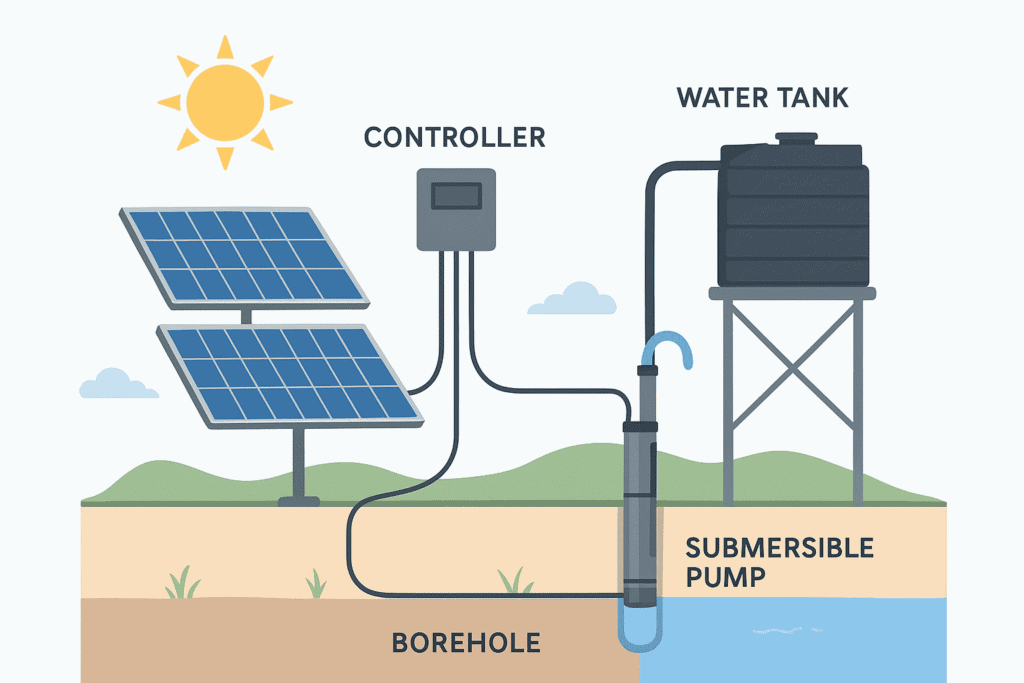
Here’s the step by step process of how a submersible water pump works:
- Sunlight hits the solar panels, generating DC (direct current) electricity.
- The controller/inverter regulates this electricity, ensuring a steady flow to the pump.
- The motor, located deep inside the borehole, powers an impeller that pushes water upward.
- Water travels through pipes into a tank (such as a JoJo) or directly to irrigation systems.
Not all solar submersible pumps are the same — they come in two main types namely AC and DC.
DC Submersible Pumps
- Run directly from solar panels without needing an inverter.
- More efficient and simpler for small to medium setups (homes, small farms).
- Easier to maintain with fewer components.
- Ideal for depths up to around 60 m and daily use.
AC Submersible Pumps
- Use an inverter to convert solar DC power into AC power.
- Can handle larger volumes of water or deeper boreholes.
- Suitable for commercial irrigation systems or mixed power setups (can switch to grid if needed).
- Slightly higher cost but more flexible.
DC pumps are best for home and small farm use, while AC pumps excel in larger, high-power systems.
What About Surface Solar Water Pumps?
A surface pump is installed above ground and draws water through suction. It’s useful for shallow wells, ponds, or tanks, but can’t lift water from depths greater than 7m.
In contrast, submersible pumps sit underwater and can lift water from 50 m to over 100 m deep. If you’re pumping from a borehole or deep well, a submersible solar water pump is the clear winner. Surface pumps, however, are ideal for garden irrigation or transferring water from tanks to fields.
Where and When to Use a Submersible Water Pump
Submersible solar pumps are versatile and fit a wide range of needs in Zimbabwe:
- Farms: For irrigation or livestock watering, especially where boreholes are deep.
- Rural/off-grid homes: Where ZESA power is unreliable or unavailable.
- Urban homes: For cities like Bulawayo that face frequent water cuts.
- Community projects: For schools, clinics, and villages seeking independence from fuel or grid power.
In regions like Mashonaland East or Midlands, where boreholes can be over 50 m deep, submersible solar pumps are especially practical.
Sizing and Key Technical Aspects
Getting the right size is crucial. An undersized pump won’t lift enough water, while an oversized system wastes money. To size your water pump correctly, you’ll need to consider:
- Depth (or head) – how deep your borehole is.
- Flow rate – how much water you need per day.
- Panel placement – they must get full sunlight for at least six hours daily.
We also need to look at the specifications of the pump and solar panels namely:
- Pump power (HP): The drawing or pulling power
0.5 HP – shallow boreholes (20–30 m), home use. 1 HP – medium farms (40–60 m).1.5–2 HP – deep boreholes (80–100 m), commercial irrigation. - Max head: The vertical distance the pump can lift water.
- Flow rate: Litres per hour or day.
- Solar array size: The number and wattage of panels needed.
Quick checks:
- A 1 HP pump needs around 4–6 solar panels (300–400 W each).
- It can deliver 40–120 litres per minute, depending on the head and model.
- Always match the pump’s voltage and current requirements with the panels and controller.
Costs and Payback
Typical installation costs (2025 prices):
- 0.5 HP systems: USD $500–$900
- 1 HP systems: USD $1,000–$1,800
- 2 HP systems: USD $2,000–$4,000
While the initial cost may seem high, most farmers recover the expense within 2–4 years through savings on fuel and electricity. After that, the water is virtually free.
Installation and Maintenance
- Install panels in a north-facing direction with a 10–15° tilt.
- Keep panels clean and dust-free for optimal output.
- Protect cables and controllers from animals and rain.
- Inspect pump performance annually — flow rate, voltage, and pipe connections.
Conclusion
A submersible solar water pump is one of the best long-term investments for anyone serious about water independence in Zimbabwe. It’s efficient, sustainable, and pays for itself over time. Whether for farming, livestock, or household use, a well-sized system provides peace of mind and consistent water supply even when power is unreliable.
Ready to take the next step?
Contact Solar Energy Scout for a custom quote, site visit, or solar system sizing that fits your borehole and budget.